


Sign up below to receive monthly eMHPrac newsletters and updates about the latest digital mental health news, events, and resources.

In this edition:
- The latest edition of eMHPrac’s Digital Mental Health Directory
- Randomised controlled trial of DadBooster
- Course for health professionals – conversations with clients about AI
- New youth suicide safety planning guidelines
- Read out recent blog on creating the WellMob video series
- A word from WellMob on Indigenous Literacy Day
- See the eMHPrac team at these upcoming conferences
- Read the latest articles on digital mental health
- Shape the sector through research on digital mental health in practice
- This month’s featured service: The Shared Table
Latest Update of eMHPrac’s Digital Mental Health Directory
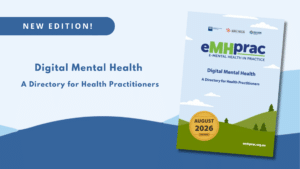
The August edition of eMHPrac’s Digital Mental Health Directory for Health Practitioners is now available. This directory features trusted Australian digital mental health services, resources, apps, websites and helplines to support clinical practice and patient care.
New additions include Medicare Mental Health Check-In, Minding Your Mind, and Qwibbl, expanding the range of evidence-informed supports available. The Directory is organised by topic, audience, crisis services, and resources for Aboriginal and Torres Strait Islander peoples, making it easy to find relevant options for a variety of mental health and wellbeing needs.
Order the directory as a hard copy resource via our order form, download a copy or access our filterable online Directory.
New Randomised Controlled Trial of DadBooster for Fathers with Postnatal Depression

New research from the Parent-Infant Research Institute (PIRI) has found that DadBooster, an online cognitive behavioural therapy program designed for fathers experiencing postnatal depression, significantly improved mental health outcomes. In a randomised controlled trial involving 50 Australian fathers with clinically diagnosed depression, participants using DadBooster reported a 72% reduction in depressive symptoms over 12 weeks compared with usual care. The study also found improvements in stress, negative thinking and parenting self-efficacy. DadBooster is free for eligible Australian fathers, requires no referral, and is accredited with the national digital mental health safety standards. Read PIRI’s article about the trial, look at the published research or check out DadBooster.

AI in the Room: Free Practical Course for Health Professionals
The eMental Health International Collaborative (EMHIC) recently featured AI in the Room, a free practical course designed to help therapists navigate conversations about clients’ use of AI tools such as ChatGPT and Gemini. Developed by Davy De Geeter, Head of Partnerships of Wysa and Digital Lead for Alliance Psychological Services, the course explores how people are using AI for mental health support and what clinicians need to know. Topics include discussing AI use in therapy, documenting AI use in clinical notes, understanding emerging trends, and working through real-world case studies. The course is free to access and requires no registration.

New Guidelines to Support Suicide Safety Planning with Young People
Suicide safety planning is a practical, collaborative approach that helps young people stay safe during periods of suicidal distress. Orygen has released updated resources to support both clinicians and families in developing effective safety plans. The clinician guide outlines how to work with a young person to create a personalised suicide safety plan, the important role families can play, and common challenges that may arise during the process. They also offer a guide for parents which provides practical advice on supporting a young person’s safety and wellbeing. Together, these resources help strengthen suicide prevention efforts across services and communities.

Behind the Scenes: Creating the WellMob Video Series Through Collaboration, Culture and Care
Guest author Tiarnee Schafer, from WellMob, shares insights into the teams process and motivation behind the development of their new video series sharing practical tips for using digital social and emotional wellbeing (d-SEWB) resources with First Nations clients.

A word from WellMob
Indigenous Literacy Day – 2 September
Indigenous Literacy Day celebrated the power of literacy to strengthen learning and wellbeing for Aboriginal and Torres Strait Islander peoples. The day highlights the importance of ensuring people have access to information that is meaningful, culturally relevant, and easy to understand. Improving literacy, including health literacy, can empower individuals, families, and communities to make informed decisions that support their social and emotional wellbeing (SEWB) and overall health.
WellMob makes this easier by providing free, culturally informed SEWB and mental health resources created by and for Aboriginal and Torres Strait Islander peoples. Through videos, podcasts, websites, apps, and fact sheets, WellMob supports health professionals, students, and community workers to share trusted resources that strengthen health literacy, encourage meaningful conversations, and support wellbeing.

Catch us at these upcoming conferences
ISRII 14th Scientific Meeting
20-22 October, Newcastle, NSW
Presentation and Trade Exhibit
Digital Interventions That Travel the Distance
See eMHPrac’s Director, Heidi Sturk present on “Building Workforce Capability for Integrating Digital and Emerging Technologies into Routine Care” and visit the eMHPrac trade booth to chat with our friendly team.
Rural Mental Health Conference
4-6 November, Gold Coast, QLD
Keynote Presentation and Trade Exhibit
What Works, Where It Matters: Strengthening Integrated Rural Mental Health Systems, Workforce and Communities
Catch a keynote presentation by eMHPrac’s Director Heidi Sturk on “The Importance of Trust in a Fast Moving Technological World” and visit the eMHPrac trade booth to chat with our friendly team.
Implementation Science Health Conference Australia (ISHCA26)
26-27 November, Brisbane, QLD
Presentation
Connect with the latest thinking and build new global and local connections at ISHCA26
Catch a presentation by eMHPrac’s Director Heidi Sturk.

What we’ve been reading
Systematic review and meta analysis of chatbots in the management of depressive and anxiety symptoms
Sohn, J. S., Ha, B. G., Park, S., Kim, J. J., Lee, E., Oh, H., … & Kim, E. (2026). Systematic review and meta analysis of chatbots in the management of depressive and anxiety symptoms. NPJ Digital Medicine.
Identifying what works in mental health apps through meta-regression analyses of 169 trials
Kraiss, J., Fiß, F., Chakhssi, F., Aktas, F. B., Koelen, J. A., & Simões, J. P. (2026). Identifying what works in mental health apps through meta-regression analyses of 169 trials. npj Digital Medicine, 9(1), 336.
Massanneck, S., Seizer, L., Schmitt, N. N., Pascher, A., & Löchner, J. (2026). Immersive virtual reality psychotherapy for children and adolescents—A systematic review and meta-analysis. Internet Interventions, 43, 100920.

Shape the sector
Contribute to research that informs practice and policy
Invitation to participate in a digital mental health survey
We are currently undertaking a national survey of Australian health practitioners to examine the current knowledge, views, and use of digital mental health among the mental health workforce.
The survey takes approximately 10 minutes to complete and will inform future workforce support, service development, and policy direction in the digital mental health sector.
Participation is voluntary and you can withdraw at any time by exiting the survey. The survey is anonymous and no identifying information is collected.
Access the full study information and survey here or if you have any questions about the study, please feel free to contact us at emhprac@qut.edu.au.
Our featured service… The Shared Table
About The Shared Table
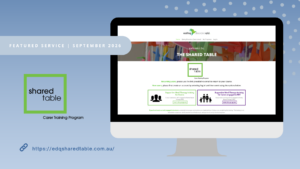
Our featured service for September is The Shared Table, an online meal support training program from Eating Disorders Queensland, for carers, family members and other support people helping a loved one with an eating disorder.
Read our blog delving into the Shared Table here.
About the author