

The digital mental health landscape is constantly growing and changing, and it can be difficult to keep up, especially for time-poor health practitioners. Fortunately, at eMHPrac we are focused on staying up to date with all the latest research and service changes. Here is a snapshot of some of the major changes to the digital mental health landscape in the last six months.
New Services
In the last six months, a few new services have been added to our Directory. Here are some of the new services we’ve been looking at:

Autistics’ Guide to Adulthood
https://autisticsguide.org.au/
Self-paced life-skills online modules to support adults with autism to achieve their goals.

Bravehearts
1800 272 831 (Mon-Fri 8:30am-4:30pm)
Information and phoneline for anyone seeking advice or help related to child sexual abuse. Not a crisis service.

Hello Change
Self-guided CBT-based online program to help adults better understand their drinking patterns and learn strategies to improve their relationship with alcohol.
Qwibbl
https://kidshelpline.com.au/qwibbl
App for young people to better understand the things bothering them (‘qwibbls’) and find personalised tools, tips and strategies to help improve their mental health and wellbeing.

Sortli
App providing information to assist young people transitioning from care to independence in adulthood. Available in Queensland, Victoria and South Australia.
Updates to Existing Services
Digital mental health services are constantly developing and updating their offerings. The following services all released updates in the last six months.

Guiding Light
https://rednose.org.au/grief-and-loss-support/overview/
1300 308 307
Webchat and telephone support for parents/caregivers and families after the death of a baby or child, with access to online peer support. Guiding Light has been renamed and is now known as Red Nose Grief and Loss.

Inside Out eClinic
https://eclinic.insideoutinstitute.org.au/
Self-guided or own-clinician-supported web-platform offering screening (IOI-S), self-monitoring tools, and CBT-based online programs for people with eating disorder symptoms and their support people.
The Inside Out eClinic SupportED program is now widely available, offering practical strategies for families supporting someone with an eating disorder (16yrs+).

TEN – The Essential Network for Health Professionals
https://www.blackdoginstitute.org.au/the-essential-network/
Online hub for health practitioners offering self-assessed mental health screening for symptoms of depression (PHQ-9), anxiety (GAD-7), traumatic experiences (PCL-5), and burnout (OBI). Also offers access to up to five free clinical telehealth sessions, evidence-based tools and online programs to navigate burnout and maintain good mental health.
TEN have added a new program on navigating sleep and shiftwork, an online program specifically developed for health professionals. It offers comprehensive guide to optimising their sleep, improving recovery, and ensuring sustained performance.

THIS WAY UP
Self-guided or own-clinician-supported screening and CBT or MBCT psychological intervention and wellbeing programs for adults with a range of mental health concerns and teens with anxiety/depression. Perinatal, student, stress and transdiagnostic programs also available.
THIS WAY UP have added a new program on worry and rumination, providing practical skills to manage symptoms, break negative cycles and help people feel better.
Discontinued Services
There are many reasons a service may be discontinued, such as loss of funding and technological changes. Unfortunately, we have had to say goodbye to the following services in the last six months.
- eFriend
- QuitCoach
- HitNet Community Hub
Digital Mental Health Safety and Quality Standards
The Digital Mental Health Safety and Quality Standards are a national standard to assess the quality, care and safety of Australian digital mental health services. They include 59 actions related to clinical and technical aspects of digital mental health services, with the aim of improving the quality of service provision and protecting users from harm.
The following services have received accreditation within the standards in the last six months:
- AIMhi-Y
- Guiding Light (now Red Nose Grief and Loss)
- Medicare Mental Health
- Stay Strong
- THIRRILI/National Indigenous Suicide Postvention Service
- Weathering Well
Professional Development for Digital Mental Health Use
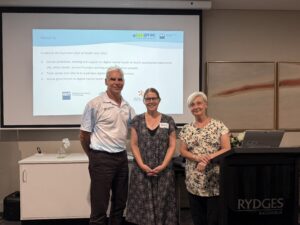
The eMHPrac team have been running several training workshops in Western Australia with GPs and Allied Health Professionals. These face-to-face training workshops focused on practical skills for:
- Build capability of GPs and health practitioners to confidently use digital mental health tools.
- Enhance access to evidence-based support for people with milk to moderate mental health conditions.
- Strengthen suicide prevention strategies through stepped care integration.
- Provide regional, culturally responsive training opportunities, particularly for Aboriginal and Torres Strait Islander communities.
These training workshops reached more than 78 health professionals. Participants shared that they found these workshops very helpful and engaging, providing insightful information on many resources and strategies that are highly relevant to their work. They found the information to be valuable, reliable and beneficial to aid health professionals in adapting to evolving technology and patient/client needs.

WellMob are constantly reviewing and adding new resources to their website to bring health workers the best digital mental health resources made for and by Aboriginal and Torres Strait Islander people. In the last six months the WellMob team have added many new social and emotional wellbeing resources to their library of over 500 online resources.
WellMob have added 3 new short videos from health and wellbeing workers sharing how they use WellMob. Aboriginal employment educator Chloe Redcliffe yarns about how she uses WellMob to support young Mob in a holistic, strengths-based way. Clinical educator Emily Wilson yarns about using WellMob to support culturally responsive practices for graduate clinicians working in headspace Nations. Trauma-informed First Nations mental health advocate Chris Lee yarns about how they use WellMob resources to make mental health care information more accessible for Mob.
This list of services is for information purposes only – a clinician should thoroughly evaluate a service before recommending it to a client. This list is not exhaustive and represents a selection of resources that can be found on eMHPrac’s website.
To find out more, please visit https://www.emhprac.org.au/ or for Aboriginal and Torres Strait Islander social and emotional wellbeing tools visit https://wellmob.org.au/.
eMHPrac provides education, training, and guidance to health practitioners and Aboriginal and Torres Strait Islander health workers around digital mental health.
For consumers wanting digital mental health support, please visit Medicare Mental Health https://www.medicarementalhealth.gov.au/.
About the author